
Bulletin 328 Volume 24 No 11 Summer 2026
The Hymn Society Bulletin
Summer 2026
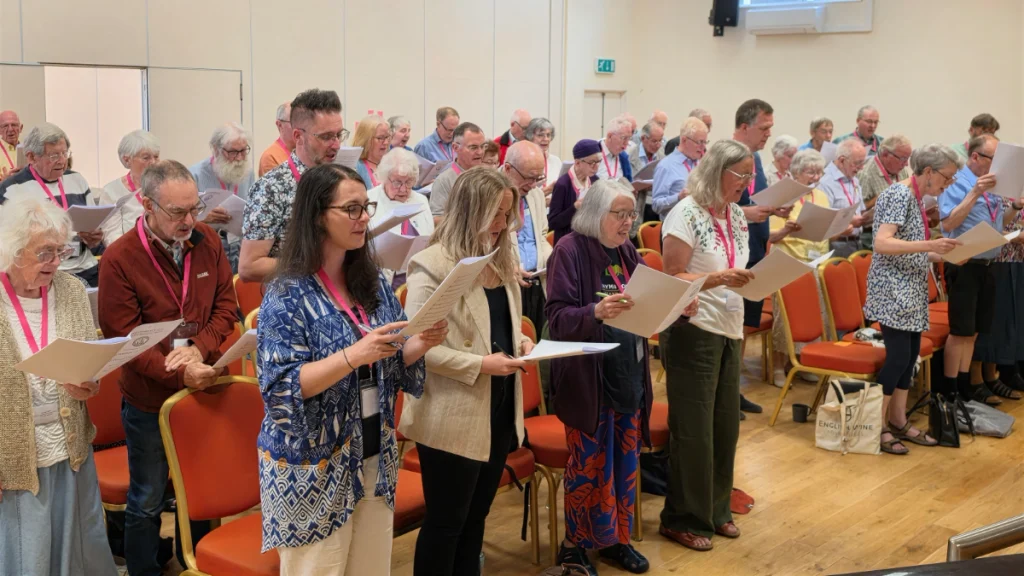
Image on Front Cover shows the conference at song.
Photograph by John Crothers, reproduced by permission.
Contents
Reflections on the 2026 Conference in Swanick by Terence Atkins, Ian Sharp, Naomi Moss, Deane Coe
The Hymn Society at 90 years old by J. R. (Dick) Watson
A Festival of Hymns 2026 by Noel Tredinnick
What does a Precentor look for in a Hymn (Book)? by Michael Gisbourne
Hymn Competition – the winners
Day Conference: ‘Singing Community: Congregational song, Community and Context’
Festival of Hymns: ‘Singing the People’s Song’
Reminiscences by Ken Bowden, Christopher Idle, Kay Griffiths
Opinions expressed in the Bulletin are not necessarily those of the Society or the Editor.Editorial
Janet Wootton
Welcome to the third issue of our ninetieth anniversary year. In these pages you will see the impact our new ideas. At the Conference, we announced the winners of our Hymn Competition, whose hymns we sang with great pleasure. We also welcomed two Stainer & Bell Scholars, who attended as part of what we hope will become a new scheme, initially enabled by the generosity of a publisher with which we have a long-standing and much valued relationship.
We enjoyed a Gala Dinner, whose after dinner speaker, our Honorary Vice President and long-time friend, Professor J.R. Watson, reminded us of the long tradition of hymnody and fellowship, which have been characteristic of the Society during its ninety years. The Bulletin continues the reminiscences of our members, and there are yet more to come next time.
That was ‘Ages Past’. The other focus of our theme, ‘Years to come’ was represented in challenging lectures, and vigorous discussion, and in the expanding age profile of our speakers and participants.
The year still has some way to run, of course. You will find here details of two more anniversary events, in Carlisle and Belfast.
This is an unusual issue of the Bulletin, in that there is only one traditional article, drawn from the programme of the conference. Following this ‘taster’, the rest of the conference lectures, along with content from other events, will find their way into future issues.
But this volume is not without substantial scholarly resources. The Festival Script is undergirded by a lifetime of love and learning in the field of hymnody. And for the last time, in the journal, we offer the list of anniversaries of hymnwriters’ births and deaths, compiled by Kay Griffiths, who also reflects on the task she has done for a number of years.
The reminiscences and reflections of many thoughtful, well-informed friends mark this moment in the life of the Society. And, as I keep saying, it’s only ten years to the Centenary! Keep watching …
Reflections on the 2026 Conference in Swanick by Terence Atkins, Ian Sharp, Naomi Moss, Deane Coe
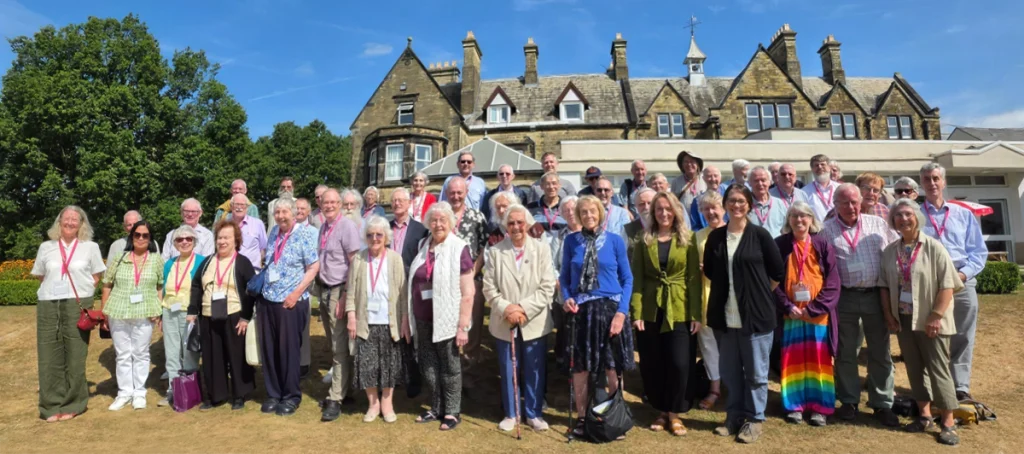
Terence Atkins
It was lovely to be back at Swanwick after thirteen years, and those of us who had enjoyed Highgate House last year or High Leigh in recent times had every expectation of a warm welcome, excellent facilities and fine food, and our confidence was fully justified. Worth mentioning that we were a goodly gathering at sixty-five, an improvement on last year, but this was only two-thirds of the number at Swanwick in 2013. Amongst the first-timers it was good to welcome our two Stainer & Bell scholars.
A quiet hero of exemplary modesty was Emma Turl, who provided reflections (and a hymn) for the four morning and evening worship sessions. We are grateful to Gillian Warson for leading these, supported by Gill Berry and willing pianists, and also to the Revd Richard Morgan for presiding at the Conference Eucharist, the only occasion we used the chapel. We sang two of Richard’s hymns, enjoyed all the more for being set to familiar tunes. All of our worship commemorated the 500th anniversary of William Tyndale’s English translation of the New Testament and so we appreciated being given copies of the readings and sermon from the Eucharist.
An innovation was delaying the morning worship until after breakfast, so no excuses for late risers! If this is to become the norm, it would be helpful to have more time allocated before the customary notices leading into the first session. Indeed, the whole conference was action-packed, as is expected, with seven outstanding lectures and a wide range of other engaging presentations. Due acknowledgement of the Society’s ninetieth anniversary was rightly made from time to time and most notably by Dick Watson (who better?), following the gala dinner, preceded by the pre-dinner drinks reception, which has become a most welcome feature in recent years and typifies the warm fellowship that is characteristic of our conferences.
Ashbourne Parish Church proved an ideal and hospitable venue for the Festival of Hymns. It was a pity that the booklet was A4 size, at variance with the A5 of all previous booklets, Bulletins and so on, and it seemed to lack the professional care and consistency in production to which we have been accustomed. Whether it was wise to combine the role of conductor with that of commentator is open to question.
It was particularly helpful that the conference pack included summaries of the lectures, and it is tempting to suggest that these be forwarded to the whole membership. The most challenging were the first and last, beginning with ‘Hospicing the old world, Birthing the new – through Hymnody’ by Graham Adams.

His very appearance was, as it were, a breath of fresh air, in contrast to my first conferences when the choice for chaps was either tie or dog-collar! I am looking forward to reading his Holy Anarchy, the first of a trilogy, welcome additions to the bookstall, as were various new publications from other speakers and members. Equally stimulating, and certainly timely, was ‘AI, Prayer and Hymnody’ by Gordon Giles, who also provided a most helpful paper. When we sang a hymn that had been generated in a trice by AI to Gordon’s specification, it rapidly dawned that we were merely singing hymnic platitudes. Some anxiety emerged in the questioning until wise words from Martin Leckebusch gave reassurance and hope for us to ponder as we went our separate ways.
Ian Sharp
After a warm welcome (on one of the hottest days of the year) we soon settled into the schedule of activities which had been carefully prepared by the organising committee. To commemorate our ninetieth year we started with some reminiscences going back to the 1960s, including a recorded memoir by Chris Idle. And after the Gala Dinner we had the treat of hearing Professor Dick Watson’s eloquent reflections on some previous Conferences and on those members of the Society who had inspired and guided us on our way. Conferences have always enabled those ‘with a common interest in hymnody’ to meet old friends and make new ones.
The Conference worship sessions were meticulously prepared by Emma Turl and Richard Morgan, especially remembering the life and work of William Tyndale. Some of the texts were from his English translation of the New Testament (1526), and it was refreshing to hear of, for instance, the ‘similitudes’, his word for ‘parables’.

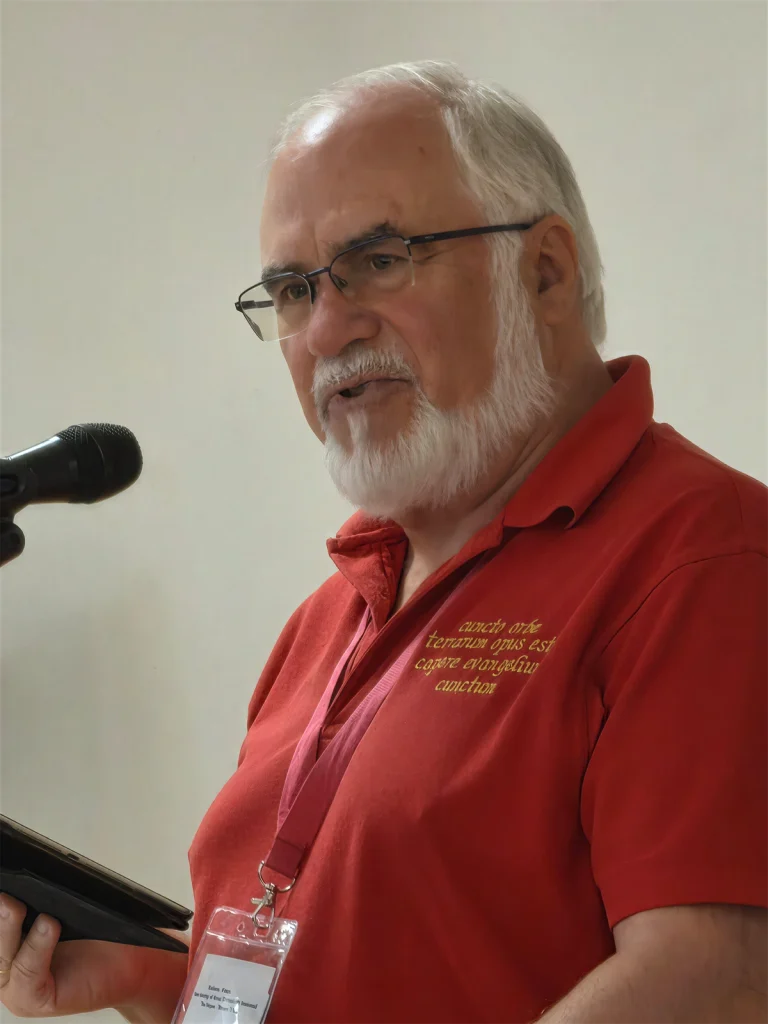

The substance of many of the lectures will undoubtedly appear in future Bulletins. Graham Adams challenged us to reflect on how the old world should be ‘hospiced’ in order to give birth to the new; implications here for hymnody! If we were curious about what a cathedral precentor looks for in a hymn (book), Michael Gisbourne gave us many insights into what happens at Ripon Cathedral. Pam Rhodes, the much-loved television and radio presenter, spoke movingly about what hymns mean to many people, and it was fascinating to hear of her extensive experience in Songs of Praise. Graham Kings presented a well-researched bicentenary tribute to Reginald Heber, and Elise Massa urged us to consider how hymns might reflect our local communities. Hugh Morris, Director of The Royal School of Church Music, asked how can we encourage people to sing the Lord’s song today? The video of children singing gave us much hope for the future, as they were clearly completely engrossed in taking part in a communal activity. Gordon Giles tackled the very relevant subject of ‘AI, Prayer and Hymnody’ with an example of an AI-generated ‘hymn’. Would it win a competition? Could it be considered as a valid part of prayer and worship?
One of the most eagerly awaited spots in Conference is always the Short Metre session, where members give ten-minute talks, usually related to their personal experience. Space does not permit me to cite the six contributions, which were all imaginatively and delightfully presented. Please, dear organisers, can we have more time allotted to SM?
Noel Tredinnick, who had already given a workshop on ‘Setting Hymns Texts to Music’, was both presenter and conductor for the Festival of Hymns held in St Oswald’s Parish Church, Ashbourne, where we were made most welcome by members of the congregation. Under his enthusiastic direction our singing progressed all the way from BOW BRICKHILL to, yes, AULD LANG SYNE! And it was a delight to hear Hugh Morris presiding at the organ.
For me, one of the high points of the Conference was the singing of a winning entry in the recent hymn competition, ‘So many voices echo through the ages’, written for the Swedish tune, SOM STRANDEN. Illustrating the theme, ‘Ages past – years to come’, this new text showed that HSGBI is in fine form to look forwards to our centenary.
On the way home, what was on my mind? Friendships, certainly, and also Noel Tredinnick’s tune, REVELATION, a perfect match for Timothy Dudley-Smith’s, ‘He walks among the golden lamps’, based on Revelation 1. The tune flows well and, as a keyboard musician, I find great satisfaction in the way in which the chords fit under the fingers. We all take different things away from a Conference!
Naomi Moss (Stainer & Bell Scholar)

The moment I arrived at The Hayes I knew I was in good company. There was a jubilant energy in the room as registration was underway and introductions were made. What soon would follow are four days of a terrifically planned musical marathon, packed with a diverse variety of lectures and workshops on all things hymn-related, with much singing, all hemmed in with times of rich liturgical worship and prayer. The days ahead would lead to new friendships cemented by our shared passion for words and music, and this would take place during the many cups of tea and wonderful meals lavished upon us during our stay. I entered into the Hymn Society at a pivotal time in celebration of their ninetieth anniversary, and had the privilege of sharing this experience with some of the very best people.
Let’s say it has not been an easy 42-year-long road that led me to Derbyshire, and yet when I came across the Stainer & Bell Scholarship and the brilliant work of the Hymn Society of Great Britain and Ireland it certainly seemed timely and very fitting that I should apply. Twenty years of working in church music has been deeply formative, and a course that I believe would have been impossible to sustain without the presence and guidance of a very gracious God, who has provided for me in every conceivable way, giving me the strength I need to persevere in the face all of kinds of circumstances, adversity and uncertainty, providing many joys and encouragements for my affirmation along the way.
It was in my late 20s that I really caught sight of who God is; the absolute beauty and perfection of His holiness arrested me. The mystery of the work of Christ on my behalf became a reality that affected all of my life. I developed a terrific appetite for memorising God’s word, and combining that with my greatest other love, namely music, was just logical to me. I finished my Masters degree in composition and for many years freelanced widely in both commercial and church music before I started the new work of Hymn Press, Ireland. The idea to produce and publish modern Irish and Scottish hymns and scripture songs was not a sudden or impulsive idea, but instead it was a gradual, growing interest and maturing that led me toward a sustained interest in this particular work. I learned that God, the Creator and finisher of our faith, is more interested in me growing in His likeness and less focused on my productivity, observing that in being drawn toward Him, dwelling with this intensely creative, masterful and spectacular God, has become wildly catalytic to my writing and composing. The Spirit indwells all who are in Christ, inspiring every form of creativity with unlimited potential for heavenly gain.
I really prayed before arriving at the conference, asking God to guide my words. I knew that it would be most authentic for me to simply speak of God and scripture. I longed to repeat the ancient songs of the bible and the bounty provided in scripture for modern lyrics, talk openly about divine beauty, inspired creativity, precision in art and the process of composition, along with themes of inexpressible joy and incomprehensible glory! As artists we strive through an artistic process in search of God. My prayers become songs, my heartbreaks become laments and petitions, my longings take the form of hopeful lyrics, and my joy dances in structured melodic lines. I seek to give voice to a light within, an otherworldly divine love that resides in my soul, somehow, to my utter amazement, by the course of grace.
Our hope in Christ unites past and present generations with truth that was never set to expire. Let us sing with themes of God’s eternal grace and mercy, faithfulness and steadfast love, promises well-kept and promises impossible for Him to break. Tasting God’s glory is a resource to free a lifetime of prolific composing. With hearts well-tuned to scripture let us pursue God to the very end, singing together words that change our minds and call us to remember His covenant promise and our divine hope who is Christ.
How can it be that we so blessed
In Christ were chosen by Your love,
According to Your gracious will
And lavish measure of Your grace.
O Blessed Hope of Christ for us,
Here full redemption through His blood
Come sing the mystery of His Grace
Set forth in Christ to bring Him praise.
Excerpt from new Irish hymn: O blessed hope (Eph. 1) by Naomi Moss
Deane Coe (Stainer & Bell Scholar)
I am very grateful for the scholarship which enabled me to participate in the Annual Conference 2026. I believe that the Lord is leading me towards a musical path within the context of worship and He has been gently nudging me towards the world of hymnody, so this conference was a timely part of the worship and musical journey where the Lord is leading me.
Many of my positive milestones have happened later in life. From being an atheist as a young man, I didn’t encounter Jesus until my 30s, got married in my 40s, had children in my 50s and now in my 60s I find myself a student at the London School of Theology (LST). It was through LST that I connected with the Hymn Society, for which I am very grateful. My music experience has mainly been in a contemporary music style of worship with only a limited exposure to hymns. Coming to the conference has opened my eyes to another world rich in history and influence for the Kingdom of God. I never knew that so many hymns had been written, and many of them by the gifted and talented people at the conference. What an honour to be among such talented, gifted and experienced people.
It was a pleasure and privilege to be part of the conference, to meet a wide range of lovely people and to assist David Lee in his practical duties.
All of the sessions were enlightening for me and most things I had heard or experienced for the first time.
The whole conference was a highlight but I particularly enjoyed and benefited from Noel Tredinnick’s workshop on setting hymn texts to music. Noel addressed questions I had been pondering for a while as well as other questions I didn’t realise I had.
The Festival of Hymns was a wonderful experience and I am very pleased that my wife and children were able to join us for this. I believe they have been inspired. Looking at the number of guests who attended the Festival reminded me of the challenge we all have as to how to promote such events. Maybe future Festivals could incorporate taking hymns to the high street.
Going forward from here, I will continue the journey of where I believe the Lord has been guiding me, namely:
- Exploring songwriting (particular setting biblical text to music);
- Training and developing people in my local church both musically and in what it means to worship God;
- Working on contemporary arrangements of hymns.
- Thanks to all I have experienced and learned at the conference, all of the above will now be framed within a wider musical scope to include more of the richness of hymnody.
The conference has inspired me to continue to proclaim the gospel of our Lord Jesus Christ but with greater diversity and richness.
Thank you all very much for such an enriching and inspiring experience.

The Hymn Society at 90 years old by J. R. (Dick) Watson

I am very grateful to the Committee for inviting me to celebrate the ninetieth year of the Hymn Society of Great Britain and Ireland. It is a privilege and honour for me to stand here on such an anniversary. The Society has meant much to me over many years, and I have made many valuable friendships in that time. I have learned much about a subject that is dear to my heart.
I hope you will also raise your minds and hearts in a salute to a remarkable achievement and to some very fine people. However, you may wish to recall that my memories go back only to 1981, and that there are others, such as my friend Ken Bowden, who joined the Hymn Society in 1961 and whose first Conference was in 1972. The mention of his name reminds me to inform you that, in what follows, he will be an exception. I have decided, having got into a mess on various occasions, to avoid talking about any living persons. The present tribute began life as an after-dinner speech, in which I was asked to reminisce about those years, to say something about hymns, and to say something about the Society itself.
I joined the Society at the suggestion of Alan Luff, who was a leading figure in its activities. It is right that his name should be the first that I mention. Alan was indefatigable in his work for the Society, which owes him a great debt for his labours over many years. The Conference was at Oxford. I did not realise it at the time, but it was the first of the joint conferences held between the British, American, and German Societies. They were all there in force, and I do not think that I realised how unusual and experimental this was. Among the delegates from America was George Shorney, President of Hope Publishing Company of Carol Stream, Illinois. George was a man of great presence and charm, as well as being an enterprising publisher, who met Timothy Dudley-Smith and Fred Pratt Green at this conference. He played a large part in the years that followed in making their hymns known in America. As an example, there is a hymn by Fred that begins ‘How clear is our vocation, Lord’, sung to REPTON. To the best of my knowledge this is not found in any British book, but it is in seventeen in the United States and Canada.
My memory of the conference is a blur, except for one moment, which has stayed in my mind ever since. John Wilson, the Head of Music at Charterhouse, and for many years the Treasurer of this Society, gave a paper from the piano on ‘English Hymnody: a look at some of the sources’. Among the tunes that he discussed were two for Horatius Bonar’s ‘I heard the voice of Jesus say’. At one point he was talking about Vaughan Williams, and he played the English traditional melody KINGSFOLD, a lovely folk tune which Vaughan Williams used in The English Hymnal. John Wilson then played, very beautifully, VOX DILECTI by John Bacchus Dykes, from the 1868 Appendix to the First Edition of Hymns Ancient and Modern. You will remember that it has a remarkable transition from G Minor to G Major (two flats to two sharps) halfway through the verse. The tune in the fourth line was marked ‘Rall.’ (though my impression is that, if it is ever played, the Rallentando is not often observed these days), and Wilson slowed it right down. He played the tune carefully and gently, laying it before us in all its original beauty.
When he finished there was, or so it seemed – and still seems to me – a long moment of complete silence, as the delegates – from Europe and Scandinavia, you will remember, and the United States, Canada and Australasia – took in the loveliness of the tune, and its fitness for the words. It struck me with wonder and admiration, as I think it struck them. My memory is that it was one of those rare moments of awe and revelation. Since that time I have come across some words that are in accord with what, I think, we all felt then. They come from Edward Henry Bickersteth, hymn editor and later Bishop of Exeter, who said of one of Dykes’s tunes – ‘it seems to me to breathe the very language of the hymn, in music’.
The following year the conference was held in Cheltenham, with the Act of Praise in Gloucester Cathedral, where Alan Dunstan was a Canon, and the year after that in Durham, and the year after that in Chichester. The last of these was sadly marked by the death of Albert Bayly, who died just after the Conference finished. He was there with his wife, but both of them seemed to be enjoying themselves quietly, and they took no part in the discussions. I was too shy to approach them, something that I now regret.
I missed some of the conferences which followed, but was back in my second university of Glasgow in 1989, in the University Chapel, where Emily Chisholm began the Act of Praise with one word, GLASGOW. It was the name of the Scottish tune for ‘Behold the mountain of the Lord’, and for a long paraphrase of fifty verses, beginning ‘Thee will I love, my Lord, my strength’. Emily said the word in her beautiful West of Scotland voice. In the context of that time and place, it was truly sublime. It brought into the meeting – with one word – that great tradition of Scottish church history and worship, the psalms and the paraphrases of the church whose motto was ‘Nec tamen consumebatur’, – ‘yet it was not consumed’ from Exodus 3:2, the story of the bush that was burning but was not destroyed. The motto stood for all those times of struggle, peril and persecution, and that word, GLASGOW, spoken as Emily spoke it, said it all.
My next vivid memory is from two years later, in 1991. It concerns one of our regular conference attenders, Basil Barendt, whom some of you will remember. He came from Frome in Somerset, where he played the trumpet in the Frome Town Band. He was very attached to that trumpet, which he played wherever and whenever possible. He was a school teacher, who used the trumpet instead of a bell, to call the children in to class from break or playtime. Many of them remembered it in later years as a distinctive element in their early educational experience.
In that year, 1991, the Conference was held at the University of Essex. We were accommodated in tower blocks, quite comfortably if you didn’t mind heights. They were quite closely spaced, and in the next tower block was a large party of Italian students, who were enjoying their visit, rather late at night, and very noisily. The following morning Basil opened his window at 7.30, stuck his trumpet out of it, and played the Reveille, fortissimo. There were complaints to the Essex management from both sides, but I never found out what the outcome was. I may be mistaken, but I think that Basil, who was incapable of an unkind thought, may have been attempting some sort of tit-for-tat, but was also inspired by the glory of the morning. He was giving his all in the joy of just being there and being alive on a lovely summer day. His soul was in that trumpet, and he was going to rejoice in life and its gifts.
Two years later we were at Winchester. This is where I have to break the intention about not speaking of anyone living, because the report that year was written by Derek Hodgson. He was a fine, upstanding and very Yorkshire Yorkshireman, who mentioned a certain Dr Janet Wootton, who (I quote) ‘gave an old-style, almost evangelistic, arm-waving delivery on inclusive language in hymnody.’ That Winchester Conference was the occasion of my first real meeting with Timothy Dudley-Smith. I was in awe of him, of course, but he quickly dispelled that by his warmth and kindness. His friendship and generosity, and his hymns, have been so much a part of my life since that time that I can never find words to express the gratitude that I feel. Timothy gave a paper entitled ‘What makes a good hymn?’ – a question that is, like much of his writing, both simple and profound. At one point he mentioned the figure-skaters, Torvill and Dean, saying that in their work he witnessed the marriage of artistic impression and technical merit. It was a lovely insight, based on two glamorous athletes, identifying two elements that form the perfection that hymns can sometimes attain.
We were back in Durham in 1997, in St Oswald’s Church, where John Bacchus Dykes was vicar for a few years. He is buried across the road from the church. We had heard that the congregation sang his tune NICAEA round his grave on Trinity Sunday, so before the Festival of Hymns we did the same. We crossed the road and sang, from memory, ‘Holy, holy, holy, Lord God Almighty’ to NICAEA and ‘Praise to the Holiest in the height’ to GERONTIUS. It was a very happy memory.
At this point I must declare, like the author of the Epistle to the Hebrews, that ‘time would fail me to tell’ of a host of friends whom I remember. My personal roll, in addition to those already mentioned, would be: Wilfrid and Hilda Little, Alan and Winifred Gaunt, Ian Stratton, Caryl and Ruth Micklem, Kenneth and Margaret Trickett, Bernard Massey, Fred and Anthea Kaan, Michael Saward, Donald Webster, Geoffrey Wainwright, Clive Young, Elizabeth Cosnett, Leslie Ivory. From this list I find that the last two deserve a special mention. I am sure that you can all think of others, but these are two whom I remember with great affection and admiration.
The first is Elizabeth Cosnett. I admire her hymns, so full of humanity and love and (sometimes) humour, and I value a wonderful essay of hers, delivered (I think) at Birmingham in 1995, entitled ‘A (Female) Bookworm reads some hymns’. The title itself is typically modest – ‘reads some hymns’ – what could be simpler? It was also gently humorous – ‘(female)’ in brackets – ‘bookworm’. The brackets, and the word ‘bookworm’ are nicely comic. In her talk Elizabeth made a point about the last verse of ‘In the bleak midwinter’: ‘If I were a shepherd, I would bring a lamb, If I were a wise man, I would do my part’. She observed that ‘when a woman wrote these words women were largely excluded from the professions and from higher education.’ It was a reminder, quietly put, but devastating in its condemnation of inequality and injustice.
The second was Leslie Ivory. Leslie was a brave man. As Sergeant Ivory he was parachuted into Normandy two days after D-Day in June 1944. In peacetime, as the Reverend Leslie, he was an enthusiastic member of this Society. From about April onwards each year, his letters to me always began in joyful anticipation with the words ‘Nearer and nearer draws the time…’. Beginning his report on the Plymouth Conference of 1996, he said in the first sentence that ‘for many of us the annual conference of the Hymn Society is the highlight of the year.’ Two years before, at Newcastle in 1994, Donald Webster had reported that ‘the genial chairmanship of the Revd Leslie Ivory prevented an occasionally controversial “Short Metre” session from becoming acrimonious’. It can readily be imagined that someone who had parachuted into a battlefield in 1944 would, exactly fifty years later, have had little problem with quarrelsome Short Metre participants in 1994.
So we are, to quote from Hebrews once again, ‘compassed about with so great a cloud of witnesses’, and conscious of the heritage that they have left to us in the singing of hymns. We do so in admiration for them, and the ways in which they have kept alive, and added to, the great tradition of hymnody that goes back to the earliest years of Christianity and continues to the present day. It is important to see every hymn as being a part of a great whole, an individual expression of belief, or penitence, or triumph, or gratitude, of all the elements that we group under the heading of praise and prayer. When a particular hymn is announced, we instinctively, I think, put ourselves into a position of readiness to be joyful, or sad, or triumphant, or grateful. And this is good for us. It is good for us to be taken out of our normal self-centred lives into a sharing with others in the contemplation of some aspect or other of the divine humanity. As we stand to sing, we shake our fist at aspects of the world’s pointlessness and wickedness.
Some hymns do this very beautifully. Think of the chiasmus in ‘When I survey the wondrous cross’:
See from his head, his hands, his feet
Sorrow and love flow mingled down;
Did e’er such love and sorrow meet.
There it is, in a few words that contain within them a world of meaning: God’s sorrow for the state of the world, with its wars and factions, its ambitions and selfishness; and God’s love for it. Or take Sir Robert Grant’s description of that love and care for us in the world:
It streams from the hills,
It descends to the plain,
And sweetly distils
In the dew and the rain.
When we sing that to HANOVER, we are celebrating the air that we breathe and the natural world which is all about us. We are paying homage to life itself. Or think of Martin Luther in 1529, writing ‘Ein feste Burg ist unser Gott’, celebrating the power and majesty of the Creator and provider.
Obviously there are many different kinds of hymn, and everyone will have his or her favourites, and views, often strong ones, about good and bad hymns or tunes, ones that they like or dislike. I do not think that any purpose can be served by discussing this. There are, in my view, two important publications that shed light on these murky waters. The first is James Montgomery’s ‘Introductory Essay’ to The Christian Psalmist of 1825. In the second part of this essay there is, I believe, a marvellous account of what makes a good hymn. The second is Timothy Dudley- Smith’s A Functional Art, published by Oxford University Press in 2017, and modestly sub-titled ‘Reflections of a Hymn Writer’. Chapter 4 is entitled ‘Good and Not So Good’. It ends with Timothy asserting what he calls ‘the basic truth about hymns, that they are designed to be sung together’. He was echoing words by W.F. Lofthouse, the great Methodist scholar of yesteryear. Lofthouse wrote, ‘Singing hymns means singing them together… we are not like the ignorant Corinthian Christians, bringing their own lunch to the Lord’s Table, and eating it in their own corner. If he [my brother – this was written before the time of inclusive language] rejoices to sing “Count your blessings” while I long for Addison’s “When all thy mercies, O my God”, the sentiment is the same. Is Addison’s the only language understood in the heavenly courts?’
What I think an occasion like this does is to make us aware that preferences are inescapable, but in the end they do not matter. I have a list of hymns that I think far worse than ‘Count your blessings’, and another list of my favourites, and the remainder somewhere between the two. I suspect that we all do. But our own likes and dislikes are of no significance, as Lofthouse and Dudley-Smith have told us.
I would like to conclude with a personal reference. I had a colleague, a brilliant scholar and a fine poet. In his sixties, he was diagnosed with cancer of the oesophagus, from which he died. During his last years he wrote poems, many of them hard to read because they were expressing his feelings about his treatment, his pain, and his dying. He entitled one of his books Return of the Gift. I think he knew in some way that he was returning the gift of his life of sixty years to the giver.
I want to suggest that something of the same process is going on in the singing of hymns, and in our recollections of those who have gone before, whose names we have remembered. And each of you will no doubt have other memories than mine, of those whom I have forgotten to mention, or who have slipped from my mind. As we celebrate our ninety years of the singing and study of hymns, let us honour those who have gone before us, singing and writing about the hymns that they loved. They were returning their gifts to the giver, as we are whenever we stand to sing, or write about hymns, or hold meetings about them. We are giving thanks for life itself, as I think Basil was when he played the trumpet from the tower block that morning in Essex, all those years ago. We follow in the footsteps of our friends in light, trusting in the hymns that we love to cheer us in times of doubt and trouble, comfort our sorrows, and brighten our happy days.
This tribute began life as an after-dinner speech, but at this point I cannot propose a toast. Instead, I would like to suggest something that may be better. I would invite us all to stand and sing Thomas Ken’s great doxology, with ninety years of the Hymn Society of Great Britain and Ireland in our minds:
Praise God, from whom all blessings flow;
Praise him, all creatures here below;
Praise Him above, ye heavenly host;
Praise Father, Son, and Holy Ghost.
A Festival of Hymns 2026
HSGBI Conference: — St Oswald’s Parish Church, Ashbourne Thursday 23 July 2026, 7.45 pm
Hymns introduced by Noël Tredinnick Organist: Hugh Morris
Welcome
A Festival of Hymns is always an important and distinctive occasion for our Society. I like to think of it as a marker in the sand: an opportunity to say something about where hymnody has come from, where it is now, and where it might be going. It is also, in a sense, a shop window. The hymns we choose tell us something about what we value: good words, good theology, good music—and, above all, hymns that congregations will actually want to sing.
Tonight’s selection has been shaped partly by anniversaries, by writers who perhaps deserve to be better known, and by our wish to explore different periods and traditions. But there is another, more personal, element. I wanted to share something of my own story: some of the hymns that have accompanied me, formed me, challenged me and delighted me throughout a lifetime of worship and music-making.
So these twelve hymns are partly a hymnological survey—and partly an autobiography in twelve chapters. Some have been with me since childhood; some I have discovered only recently. Some were written by friends and colleagues. And one or two emerged from collaborations in which I myself had a hand. We shall travel from Thomas Kelly in 1815 to Stuart Townend in 2010; from Victorian hymnody to folk melody and contemporary Christian song.
But there is one thing that unites them all: they are hymns to be sung.
Civilla D. Martin wrote: ‘I sing because I’m happy.’[1] Perhaps tonight we can turn that around: ‘I’m happy because I sing.’
We begin with the oldest hymn in our selection: Thomas Kelly’s We sing the praise of him who died, written in 1815.
- We Sing the Praise of Him Who Died[2]
Words: Thomas Kelly (1769-1855)
Tune: BOW BRICKHILL — Sydney Nicholson (1875-1947)
There is no anniversary attached to this choice. It is here because I love it. From the age of seven, when I became a chorister, the Royal School of Church Music has been one of the great formative influences on my musical life. And it is particularly appropriate that our organist tonight is Hugh Morris, the present Director of the RSCM.
As a chorister—and later as House Captain, Head Chorister and House Master—I enjoyed many RSCM residential courses, many at Addington Palace, others, particularly in the summer, here in Derbyshire, at St Elphin’s School, Darley Dale. Two tunes drilled into us on those courses became lifelong friends: BOW BRICKHILL and CORNWALL. We shall sing both tonight.
Listen to the way the melody gathers momentum and rises towards those great climaxes: ‘sweetens every bitter cup’, ‘gilds the bed of death’, and finally ‘the angel’s theme in heaven above.’
Thomas Kelly gives us profound reflection on the Cross; Sydney Nicholson gives it a melody that seems to know instinctively how a congregation sings. Nicholson knew the singing voice. His career took him to Carlisle and Manchester Cathedrals, Eton and Westminster Abbey, and in 1927 he founded the School of English Church Music, which became the RSCM.
For me, this is more than our first hymn. It is a return to the beginning: Nicholson’s rolling melody, just in the same style as Elgar and his rolling Malvern Hills, the great climax—and, if I may say so, that very familiar RSCM tradition of a special last verse and descant. It takes me straight back to those courses at Darley Dale for that is one of the great gifts of hymnody: a hymn is never simply music. It can carry a lifetime of memory.
Thomas Kelly lived from 1769 to 1855—a period in which the musical world changed almost beyond recognition. Mozart was still alive when Kelly was born; Beethoven and Schubert transformed the musical landscape; and by the time Kelly died, Mendelssohn had already been dead for eight years. And yet, more than two centuries after this hymn was written, we are still singing it. That is quite a testimony.
- For the Music of Creation[3]
Words: Shirley Erena Murray (1931-2020)
Tune: EVERTON — Henry Smart (1813-1879)
Our second hymn takes us from Ireland to New Zealand—and from Thomas Kelly to Shirley Erena Murray.
‘For the music of creation’ seems almost made for a Festival of Hymns. It is full of music: singing, instruments, psalms, symphonies and the joy of creation itself. The Victorian composer Henry Smart gives us EVERTON (no doubt our new British Prime Minister would approve!), a sonorous and colourful melody, perhaps best known through ‘Son of God, eternal Saviour’.
Shirley Murray was a New Zealander, a Methodist, a linguist and a major hymn writer. Her collection Every Corner Sing was particularly important in the development of inclusive language in hymnody. She was also an FRSCM—another connection with our Society. But it is her words that matter now.
Over discord and divisions, music speaks your joy and peace.
That is an aspiration for hymnody—and perhaps for the Church itself.
- Great God, we Praise Your Mighty Love[4]
Words: Alan Gaunt (1935-2023)
Tune: CORNWALL — Samuel Sebastian Wesley (1810-1876)
There is a problem with choosing only twelve hymns. It is rather like Desert Island Discs: once you are told you can have only a certain number, you immediately think of all the others you want!
There is an Alan Gaunt hymn I particularly love: ‘Praise for the mighty love, which God through Christ made known.’ But tonight we have another Gaunt text: ‘Great God, we praise your mighty love.’ Alan was an important figure in modern British hymnody and a long-standing supporter of the Hymn Society.
And he gives us the opportunity to remember Samuel Sebastian Wesley, whose 150th anniversary we mark this year. Wesley gave Anglican hymnody a remarkable collection of tunes: AURELIA, HEREFORD, HAREWOOD, ALLELUIA—and, of course, CORNWALL. Being a Cornishman myself, I could hardly leave it out!
I first knew CORNWALL as a boy chorister, singing it to Charles Wesley’s ‘O love divine, how sweet thou art.’ I could never sing it enough. There is something about its broad melodic sweep that invites a congregation to open its lungs—and its heart.
Wesley could be difficult, but he was a hugely influential figure in Victorian church music.
Perhaps I may be allowed another little personal indulgence. I love this tune.
- He Walks Among the Golden Lamps[5]
Words: Timothy Dudley-Smith (1926-2024)
Tune: REVELATION — Noel Tredinnick (b. 1949)
Now we come to perhaps the most autobiographical hymn of the evening. This year marks what would have been the centenary of Timothy Dudley- Smith’s birth.
Timothy was not merely an eminent hymn writer. For me, he was part of the landscape of my professional life. Our paths first crossed in 1972, shortly after I became Organist and Musical Director at All Souls, Langham Place. My Vicar was Michael Baughen, himself a composer and songwriter. Michael and Timothy had both worked for the Church Pastoral Aid Society, and through Falcon Books they became involved in developing new Christian song and hymnody.
The success of Youth Praise led to Psalm Praise,[6] published in 1973. David Peacock and I were invited to contribute, and I began writing tunes for words by, among others, Timothy Dudley-Smith. ‘He walks among the golden lamps’ was based on Revelation chapter 1.
I remember exactly how the tune came about. In May 1972, after a heavy day’s teaching at a boys’ school in Beckenham, I found myself at my mother-in-law’s Bechstein piano. I had noticed that several of Timothy’s texts were in C major. My fingers wandered over the keys, and somehow the words began to dictate the music.
I wanted dignity, splendour and mystery—and a growing sense of awe as the hymn approached its climax. The tune became REVELATION. It appeared in Psalm Praise and subsequently in Hymns for Today’s Church.[7]
Over the years I had the privilege of setting several other Timothy Dudley-Smith texts, including ‘God whose love is everywhere’, ‘Born by the Holy Spirit’s breath’ and ‘God of unchanging grace’. But tonight we return to the beginning. This is Scripture transformed into song.
- At the Cross of Jesus I Would Take my Place[8]
Words: John Eddison (1916-2011)
Tune: EVELYNS — William Monk (1823-1889)
Our next hymn gives us another anniversary: this year marks 110 years since the birth of John Eddison. I always admired John enormously. He had a particular gift for communicating the Christian faith to children and young people. Through the Church and Sunday School Movement and later Scripture Union, he became a much-loved preacher, storyteller and evangelist. His language is straightforward—but never superficial.
In the early 1980s I encountered two of his hymns that stayed with me. One was ‘Father, although I cannot see the future you have planned.’ The other is tonight’s hymn: ‘At the cross of Jesus I would take my place.’ It is unapologetically Christ-centred.
And William Monk’s tune, EVELYNS, is one of those wonderful Victorian melodies that speaks immediately to the singing voice. Monk gave us the tunes to ‘All things bright and beautiful’, ‘Soldiers of Christ, arise’, EVENTIDE and the tune of ‘Abide with me’.
The great Victorian hymn composers understood something very important: that theological seriousness and singability can live together. So Eddison and Monk meet at the Cross. Let us sing it simply, warmly and without reserve.
- Welcome, Happy Morning[9]
Words: John Ellerton (1826-1893)
Tune: NOEL NOUVELET — French traditional melody, arranged by Martin Shaw (1875-1958)
Our next anniversary belongs to John Ellerton, born 200 years ago. Ellerton is the author of ‘The day thou gavest, Lord, is ended’ and ‘Saviour, again to thy dear name we raise’. But tonight he gives us something quite different: ‘Welcome, happy morning’.
The tune is the French melody NOEL NOUVELET, arranged by Martin Shaw—familiar to many of us through Now the green blade riseth. So English words meet a French folk melody. And what a contrast this is after the Cross. The melody dances. The morning becomes a symbol of resurrection, renewal and new life.
It reminds us of the great revival of folk melody associated with Percy Dearmer, Martin and Geoffrey Shaw and Ralph Vaughan Williams. They understood that the Church could gather musical treasures from outside its traditional repertoire and give them new Christian meaning. So here is something radiant: a dance of resurrection.
- Fairest Lord Jesus[10]
Words: 17th-century German text, translated by Lilian Stevenson (1870-1960)
Tune: ASCALON — Silesian traditional melody, arr. Noel Tredinnick
We stay for a moment with folk melody. ‘Fairest Lord Jesus’ has a fascinating history. Its words derive from a seventeenth-century German hymn, while the melody is a Silesian folk tune whose precise origins remain uncertain. The English version is associated with Lilian Stevenson, an Irish Christian and peace activist. What attracts me particularly is the simplicity of the devotion. Jesus is contemplated as beautiful, pure and radiant:
None can be nearer …
than Thou, my Saviour, art to me.
The tune has that unmistakable old-world quality which can make a congregation become very still. I have arranged the melody under the name ASCALON.
We sing verse three a cappella. Sometimes the best way to experience a hymn is to remove everything except the people who are singing it.
- Light of the World, Defender and Delight[11]
Words: Christopher Idle (b. 1938)
Tune: TOOLEY STREET — traditional/unknown melody, arranged by Noel Tredinnick
We heard a reminiscence from Christopher Idle during this Conference (printed at pp. 460-1 in this issue), and I am delighted that he has also been honoured as a Vice President of the Hymn Society. Christopher’s output is astonishingly large, but his standards remain remarkably high.
Here things become personal again. Christopher is a neighbour of mine in Herne Hill. During the lockdowns of 2020 and 2021, we were both trying to remain creative while confined to our homes. I would write tunes and send them to Christopher. Sometimes, remarkably quickly, he would send back a new text to fit one of them. That is not quite the usual order of events!
The tune we are about to hear has a particular history. As a teenager, through my connections with Southwark Cathedral, I attended a grammar school in Tooley Street. At the beginning and end of each halfterm we sang George Matheson’s ‘Gather us in, thou love that fillest all’ to this tune. Years later I wondered whether Matheson’s words could be brought into contemporary language.
Christopher and I eventually agreed that they could not be modernised satisfactorily. But Christopher’s response was essentially: ‘We can’t waste a good tune’, and so came the new hymn: ‘Light of the world, Defender and delight’. Its four stanzas move through the Father, the Son, the Holy Spirit, and finally the freedom we have in the life of the Trinity.
A new text for an old melody. And perhaps that is one of the ways hymnody remains alive.
- Great God, Your Love has Called us Here[12]
Words: Brian Wren (b. 1936)
Tune: MELITA — John Bacchus Dykes (1823-1876)
We now come to another double anniversary. John Bacchus Dykes died 150 years ago, and Brian Wren was born in 1936. Dykes gave us some of the great melodies of Victorian hymnody: NICAEA, ST GODRIC, MELITA and many others. Tonight it is MELITA.
The words are by Brian Wren, one of the major hymn writers of the modern Church. Brian, like Alan Gaunt, has had a long association with the Hymn Society and with the development of modern congregational song. There is an interesting story behind the opening words. The hymn originally began: ‘Lord God, your love has called us here’. Brian later revised the text, particularly in response to his developing understanding of theological language.
Tonight we sing: ‘Great God, your love has called us here’. It is a long hymn, but beautifully structured. It begins with God’s love calling us together and ends with freedom, joy and service. And there is even a small musical question at the very beginning. Where does the emphasis fall? The music itself makes us think carefully about where the words land. That is one of the delights of hymnody: the music can change how we hear the theology.
- We Sing a Love That Sets all People Free[13]
Words: Joyce Boyce-Tillman (b. 1943)
Tune: WOODLANDS — Walter Greatorex (1877-1949)
Our next hymn is one of my discoveries of recent years. I first encountered it while looking through the latest edition of Scotland’s Church Hymnary. I wondered whether it was really possible—or necessary—to write yet another text to Walter Greatorex’s magnificent tune WOODLANDS. We already have ‘Tell out, my soul’, ‘Far round the world’ and ‘Lift up your hearts’. Wasn’t that enough?
Then I read Joyce Boyce-Tillman’s words, and changed my mind. I first met June Tillman, as she then was, when we were both involved in judging a BBC television New Hymns competition in 1985. So there was already a personal connection.
But what particularly attracted me was the way each stanza arrives at a simple prayer:
come, living love…
come, caring love…
come, strengthening love…
come, pilgrim love…
come, joyful love…
live in our hearts today.
It is a hymn about love, community, journey and transformation.
Walter Greatorex himself was deeply involved in education, and WOODLANDS has an extraordinary sense of movement and life.
I am delighted to introduce this hymn to a wider audience tonight. I hope it becomes one of those happy discoveries that leaves Ashbourne with us—and finds its way into our churches.
- Creation Sings the Father’s Song[14]
Words and music: Stuart Townend (b. 1963), Keith Getty (b. 1974) and Kristyn Getty (b.1980)
When I was invited to select items for this year’s Festival, I made one stipulation. If I was going to do it, I wanted the freedom to include at least one example of what is often called contemporary Christian music. That freedom was given to me. So here it is.
I am an admirer of Graham Kendrick, but I have a particular admiration for Stuart Townend. Stuart is a superb craftsman with words. His writing is theological, memorable and highly singable. Rather than choose the familiar ‘In Christ alone’, I wanted another example.
‘Creation sings the Father’s song’ is a collaboration with Keith and Kristyn Getty, and the partnership between words and music is important. Good hymn writing is often a dialogue: ideas, revisions and musical possibilities passing between writer and composer.
This song has a strong pulse, modal colour and forward-moving energy. I particularly admire its theology. The second verse moves from creation to incarnation: the eternal Christ enters time, the plan of reconciliation is revealed, and through his death we are set free. That is a great deal of theology to carry in a song, yet it remains memorable and singable.
Stuart has written many other substantial hymns and songs: ‘How deep the Father’s love for us’, ‘The Lord’s my shepherd’, ‘See, what a morning’, ‘The power of the cross’ and many others.
I have conducted and introduced this hymn on numerous occasions, and I remain convinced that it deserves to be sung more widely. So here, near the end of our Festival, we deliberately place contemporary Christian song alongside two centuries of hymnody. This is not because everything modern is good, or because everything old is better, but because good hymnody can emerge in every generation.
- We Worship God in Harmony[15]
Words: Michael Baughen
Tune: AULD LANG SYNE — Scottish traditional melody, arranged by Noel Tredinnick
And so we arrive at our final hymn. Michael Baughen has already appeared in our story tonight, particularly in connection with Psalm Praise and the development of new congregational song. There is a long tradition, particularly associated with Jubilate Hymns,[16] of taking an existing melody—folk, instrumental or even secular—and giving it new Christian words. A familiar tune can suddenly be heard in a new context.
Tonight we take one of the most familiar Scottish melodies in the world: AULD LANG SYNE. The story goes back to 1986, when the All Souls Orchestra travelled to Scotland for Prom Praise concerts in Glasgow, Dundee and Edinburgh during the Commonwealth Games. Michael Baughen was then Bishop of Chester, but he maintained a close interest in his former London musicians.
And came the thought: Why not take ‘Auld Lang Syne’ and give it Christian words? The purpose was not to make fun of the original, but to take its themes of friendship, fellowship and hope and place them within the unity of the Christian Church.
Michael wrote: ‘We worship God in harmony’. The hymn received its first performance at the Usher Hall in Edinburgh as the finale of the Prom Praise concert. And it worked. People sang, and joined arms. And the familiar Scottish melody had become a hymn about being one in Christ. And that makes it, I think, the perfect way to end tonight.
Because look where we have travelled. We began with Thomas Kelly in 1815. We have heard Victorian composers and modern hymn writers; folk melodies and newly composed tunes; familiar music in new settings and new music alongside the old. We have celebrated anniversaries and remembered friends. We have discovered hymns that deserve to be sung more often.
And, for me personally, we have travelled through memories stretching from childhood to the present day. But most importantly, we have not merely talked about hymns; we have sung them.
That is the extraordinary thing about hymnody. A hymn may begin as words on a page; a composer gives it a melody; an arranger gives it harmony; a publisher puts it into a book. But eventually, if it is to become a hymn in the fullest sense, it has to leave the page and enter the mouths and minds and hearts of ordinary people.
And once a congregation sings it, something remarkable happens. The hymn no longer belongs only to its writer or composer. It becomes ours. Tonight twelve hymns have become one act of worship. Different centuries, countries, musical languages, generations, but one congregation, one voice, one faith.
And perhaps that brings us back to where we began.
Civilla Martin wrote: ‘I sing because I’m happy.’ Perhaps tonight we can indeed say it the other way round: ‘I’m happy because I sing.’
When words and music bring hearts and voices alive together, something happens that neither words nor music can achieve alone. That is the privilege of congregational song; it is why hymns matter; and it is why we are here.
So, as our Festival draws to its close, let us allow one final familiar melody to do what hymns have always done at their best, to unite us in faith, in fellowship, and in our Lord.
Thank you.
[1] From a hymn by Civilla D. Martin (1866-1948), ‘Why should I feel discouraged?’. The refrain begins, ‘I sing because I’m happy.’
[2] Hymns for Today’s Church 1982, 1987. Hodder and Stoughton, London, 146.
[3] Sing Glory. Hymns, Psalms and Songs for a New Century . Jubilate Hymns. Kevin Mayhew, Stowmarket, Suffolk. 1999, 36.
[4] HFTC, 299.
[5] HFTC, 177.
[6] London: Falcon Press, 1973.
[7] London: Hodder & Stoughton, 1982.
[8] Praise! Psalms, Hymns and Songs for Christian Worship. Praise Trust, Darlington. The Bath Press 2000, 414.
[9] HFTC, 166.
[10] HFTC, 209.
[11] Not yet published.
[12] HFTC, 480.
[13] Church Hymnary Fourth Edition. Norwich: Canterbury Press 2005, 622.
[14] https://www.stuarttownend.co.uk/song/creation-sings/, accessed 29/8/2026.
[15]Let’s Praise! The Worship Songbook for a New Generation. Marshall Pickering, Basingstoke 1988, 218.
[16] https://www.jubilate.co.uk/, accessed 5/9/2026.
What does a Cathedral Precentor look for in a Hymn (Book), by Michael Gisbourne [1]
Following feedback from the Summer 2025 Conference in Northamptonshire, there was the suggestion that a Cathedral Precentor should be invited to speak on what a cathedral precentor looks for in a hymn book. I deliberately chose this punctuation as there is no one published hymn book that could possibly contain all the hymns that might be needed to cover the huge variety of worship opportunities. It is not necessarily a hymn book that I look for, but hymns.
I asked colleagues across the forty-two Anglican Cathedrals in England, ‘What do you look for in a hymnbook?’ A clearly not well-crafted question as it elicited such responses as ‘hymns’ and ‘the index’, not, perhaps sadly, ‘sound doctrine’ or ‘vibrant theological imagery’!
Before I explored the question more deeply, I explained the context I work in daily.
A personal context
Firstly, I have been the Precentor at Ripon Cathedral for eight years following twenty-six years in parish work across three dioceses.
A Cathedral context
Secondly, the Theos report ‘Living Stones’[2] published in early 2026 makes the following claim: ‘Cathedrals are more than big churches.’ It says cathedrals are:
- Churches serving whole regions rather than single congregations;
- Community hubs and centres of civic life with significant bridging and symbolic capital;
- Sanctuaries of stillness for unhurried spiritual exploration;
- Partners in interfaith work;
- Centres of arts, music, and culture of national standing;
- Providers of formal and informal music and religious education;
- Stewards of nationally significant heritage and centres of tourism.
The report shared some survey data that suggested that 77% of English adults had visited a cathedral in the last three years, and 74% of those who had visited did so for a religious purpose.
It is always a great joy to greet some of those pilgrims and visitors who come to Ripon cathedral perhaps seeing it as a heritage destination, a place of culture, or even a holy place, and then finding there a living faith.
I often describe Ripon Cathedral as
- being a place of heritage, having the oldest fabric of any English Cathedral that has been in constant use, but we are so much more than that…
- being an events venue hosting concerts covering a broad range of music, but we are so much more than that.
- being a place of culture, hosting exhibitions using many different media, but we are so much more than that.
We are certainly not a Re-enactment Society. We are, however, a place to find support and space, stillness and significance, seriousness and spiritual experience. We are a place where God is praised as Creator, Jesus is proclaimed as redeemer Lord and where the Spirit is worshipped as Sustainer.
So, worship is still seen as important at Ripon Cathedral, but so often it is the English choral tradition that attracts. Ripon currently has the largest treble or soprano line of any English cathedral with around sixty- five children and young people aged eight to seventeen. And, when you have that number, you can have stunning choral singing. And you can certainly engage with a spirituality through that, but much of it is the congregation listening to psalms, canticles, and anthems. Congregational singing of hymns and worship songs can often be perceived as an after-thought. At Ripon we would traditionally sing 4 hymns on a Sunday morning, two at a Sunday Evensong and then one at a midweek Evensong if we are observing a saint’s day.
The context of my role as Precentor
The way things are run in Ripon is that the Director and Assistant Director choose the settings and anthems for the choir to sing. I choose the hymns.
I asked Artificial Intelligence what a precentor was – it responded saying, ‘A senior Anglican cathedral cleric responsible for planning, managing, and leading worship, liturgy, and music’. A colleague put it more poetically saying, ‘My job is to oversee the liturgical logistics and the quiet choreography that, together, go into creating the invisible landscape that leads people into worship.’
A Cathedral Dean once said to a colleague who was beginning a new ministry as a Precentor, ‘you really are the only air traffic controller in a two-runway airport’. My go to image of my role is that of a train driver. No one knows who is driving, but everyone knows if the job is done badly with sharp braking and spilt coffee.
Practically this means having a handle on today’s act of worship with civic representatives from the region, whilst liaising with the bishop about the ordination next week, the cathedral curate for her first communion the day after, a family bereaved by a road traffic accident, an event celebrating the work of a local charity, and the local judiciary for a celebration of the legal life of the North-East region. I exaggerate, but only slightly!
I find I am constantly bringing this act of worship in to land, with half an eye on the next large act of worship a fortnight away and the other half an eye on the next large act of worship a couple of weeks after that. Each service having a different congregation and different hopes and expectations.
So, with that as a context, you will understand that the hymnody is an important part, but only a part of what I am responsible for. But it is the one thing in my context over which I have control. And it is important because in a straight choral evensong, the congregation might say only the 143 words of the Apostles Creed and ‘Amen’ once at the end or, on a Sunday, another 133 words in the confession. Hymns are the only other words that they utter.
So, I am always on the lookout for new hymns as well as the old that speak to individual and specific situations and resonate with contemporary issues, such as the environment, climate change, racism and sexism.
I do see it as important in a Cathedral context for hymn tunes to be kept alive. It is in doing that we can sing new words to recognised tunes, ‘The known unknowns’ as John Bell has put it. But in Ripon with a strong choir, we are also sing new hymns to new tunes as there is such a strong lead from the choir. I do see cathedrals as having a responsibility to keep hymn tunes alive!
If you were to ask me what I look for in a hymnbook rather than a hymn, I would say something with variety, that follows the Christian year; and has a good index. At Ripon we use The New English Hymnal but are exploring changing it – to what though? My personal favourite is the
Church Hymnary, fourth edition,[3] from Scotland as it has the best Scriptural index I have come across in a book. But who, knows, what will we choose? That is not yet known but as long it enables those who come to Ripon Cathedral to praise God as Creator, Jesus as Redeemer and the Spirit as Sustainer, I will be happy.
[1] First given as a lecture at the Hymn Society Conference, July 2026.
[2] Living Stones: English Cathedrals as Sacred Spaces in Changing Times – Theos Think Tank – Understanding faith. Enriching society, accessed 5/9/2029.
[3] Church Hymnary Fourth Edition. Norwich: Canterbury Press 2005.
Book Review Strength and Tenderness: Second Collection: Poems, Hymns, Songs, Choral Works, Piano, by Doug Constable, Llyfrau Cambria Books, 2025. Review by Stephen Page
Doug Constable’s ministry has included parishes in Bristol, Derby and Southampton as well as chaplaincies in Bristol and at Lee Abbey. He is now retired in Wales. He describes himself as ‘a progressive traditionalist and radical ecumenist, resolutely opposed to all forms of violence’. He is a prolific writer of texts and music; this is his second collection.
Like his earlier book, the contents are wide ranging. This is another anthology of poems, hymns and songs (as the first volume) but now also including choral settings and even a couple of short piano pieces. This volume begins with ‘Herbert’s Twenty-Seven’, poetic responses in sonnet form to George Herbert’s ‘Prayer 1’.
An effective choral setting of William Temple’s definition of worship moves us on from the Herbert-inspired poems.
Not all of this material is intended to be used congregationally. Some of it is very obviously for choir or soloists, some to be read aloud. There are thirty-five congregational hymns in the collection. Throughout the book there is a mixture of original music, sometimes with the author’s own texts, and some pieces to be spoken or to be sung to existing tunes.
A good example of this is (19) ‘In the church of the unlikely’, a striking text set to the SANS DAY CAROL. Less successful (in my opinion) is the setting of the text (18) ‘In Christ God’s power’ to the BLUE DANUBE WALTZ (although I applaud the sentiments behind it).
There is a fun and effective grace text set to AR HYD Y NOS (36), ‘Thanks before feasting’, which combines English and Welsh and makes reference to the members of the choir. A striking and challenging text set to a tune that may not be so well received is (37) ‘The boy who once ignored you’ – a hymn calling us to love those who have not loved us.
Amongst the choral settings are to be found the effective (55) ‘A funeral nunc dimittis’, a Welsh male voice choir setting of Psalm 126 (57), and the meditative unaccompanied SATB ‘Under Advent’ (58) with text by Nicola Slee. There is an effective Eucharistic setting (60) for congregation and SATB, originally written for use at Old Alresford Place.
Two solo and piano settings stand out for me. They are (47) ‘Love (bade me welcome)’ and (52) ‘You are my servant’. Both have beautiful melodic lines and rhythmic and harmonic interest.
There is a fine line to be trod for the composer of music for hymns. There is always a need to maintain balance between what is predictable enough to be comfortably learned and sung and the more adventurous rhythms and harmonies that make for interest and originality.
It is often the simpler settings that work the best. Julian of Norwich’s hazelnut comes to life once more in (3) ‘A little thing he showed me’. Finally, two more hymns (written with children in mind) which particularly stand out for me are (12) ‘God says to the world’, a jaunty harvest hymn, and (47a) ‘How it is (Patterns)’ – a lovely assembly text with a very singable melody. I particularly like this pairing in verse 2:
If the tortoise wasn’t slower than the hare, If the floor wasn’t lower than the chair
A very welcome publication, particularly suited to those who like to look for something a bit different to include in their own devotions or for use in worship or performance.
Stephen Page. July 2026.
Books for Review
If you have suggestions of books for review, please contact editor@hymnsocietygbi.org.uk.
Hymn Society Ninetieth Anniversary
We are grateful for funding from the Pratt Green Trust and Stainer & Bell, and also for a generous legacy from Elizabeth Cosnett, who would also have been ninety this year, much missed.
Just about two-thirds through our ninetieth anniversary year, we have a number of events and activities still in hand, or planned.
Below, you will find:
- Update on the Hymn Competition
- News of forthcoming events
- Reminiscences from Hymn Society members
Reports and items from the Hymn Society Conference appear earlier in this issue. Reports on other anniversary events will appear in a later issue.
Hymn Competition – the winners
Hymn Competition Winners were announced in two categories:
‘So many voices echo through the ages’, Colin Thompson
(original text to a well-known melody)
THORNLEIGH, Stephen Barber, to ‘Shaping Spirit, move among us’ (original tune to a text by Elizabeth Cosnett)
Details and full texts/tunes are available, subject to usual copyright restrictions, at https://hymnsocietygbi.org.uk/2026/02/annual-conference-2026/ (accessed 5/9/2026).
Day Conference: ‘Singing Community: Congregational song, Community and Context
Still time to book……
Saturday 10 October, 10 am – 4.30 pm, Carlisle Cathedral – Fratry Hall
Theme: ‘How congregational song emerges from and shapes its community context’
Leaders and Speakers:
- Iona Community (Wild Goose Resource Group)
- Hymn Society of Great Britain & Ireland
- Corrymeela Community
- Northumbria Community
- Revd Canon Peter Gunstone, Precentor of Carlisle Cathedral and Music Director of the most recent Lambeth Conference
There will be plenty of opportunity for participation and discussion and, of course, to sing together.
Details, including booking at Congregational Song: Community and Context | The Hymn Society of Great Britain and Ireland.
Festival of Hymns: ‘Singing the People’s Song’
Festival of Hymns: ‘Singing the People’s Song’
Saturday 14th November, rehearsal at 2, event at 3.30, Fisherwick Presbyterian Church, Belfast,
- Jointly organised by HSGBI, RSCM and USOC (The Ulster Society of Organists and Choirmasters).
- Presenter: Gordon Giles, Organist is Neale Agnew.
- Featuring a tune, FISHERWICK, written by John Crothers, to be premiered at the event.
Details at Hymn festival in Ulster | The Hymn Society of Great Britain and Ireland
Reminiscences by Ken Bowden, Christopher Idle, Kay Griffiths
Ken Bowden
As the longest-serving member of the Hymn Society, I am responding to the call for reminiscences. As a lifelong Methodist, it is a sheer coincidence that I joined the Hymn Society on Wesley Day, 1961 (24th May, annual subscription 10/6d!), and when I told my lady friend at the time, she immediately asked if there was a Her Society that she could join … Four years later, I took advantage of Life Membership for £4.
I’ve always been interested in hymns and hymnology, and in the 1950s when my home town of Glossop (Derbyshire Peak District) was running an annual Youth Festival, I was awarded a second-class certificate for an original hymn in 1954 and 1955, and a first-class certificate in 1956 and 1957. The latter was for my Harvest Hymn, which has been sung a few times in Rossendale, and which one of my minister friends suggested ought to be in the hymnbooks.
When the Hymn Society was founded in 1936, the annual subscription was 2/6d (half a crown), and one of the founder members was the Revd Thomas Tiplady, minister of the Lambeth Methodist Mission, who was to recommend that LOCAL HYMN-WRITING SHOULD BE ENCOURAGED! He wrote hymns to meet the needs of folk who were not familiar with the language of traditional hymnody.[1]
Personal highlights of forty years’ attendance at Hymn Society Conferences include the unforgettable Martin Ellis playing Bach’s Toccata and Fugue on Southwell Minster organ (1973), and the duet on York University organ in 1974, featuring Peter Cutts and Geoffrey Laycock. A later Conference at York (1997) held its Act of Praise in St Olave’s Church, where signs of Robert Thompson (the Mouseman of Kilburn) were evident in abundance.
‘A good hymn is the most difficult thing in the world to write’ – so spoke Poet Laureate Alfred, Lord Tennyson (according to a memoir written by his son). He further remarked: ‘In a good hymn you have to be both commonplace and poetical.’ He also said: ‘What the sun is to that flower [in his garden], Jesus Christ is to the soul – He is the sun of my soul.’
A Bacup Baptist layperson and solicitor reflected on Hymns and Psalms 449, Watts’s ‘How beauteous’ (with an instruction to think electrically), ‘Words by WATTS, tune by AMPS;[2] surely this should recharge our spiritual BATTERIES – if the thought does not make us want to re-VOLT and go OHM!’
The late Bill Jones, encourager supreme, and conductor of the Warley Male Voice Choir for fifty years, and who would have reached his centenary this year, was a regular Conference attender until domestic health problems made it impossible.
Alan Dunstan’s commendation of the tune CHRISTMAS CAROL (which was actually written for the hymn ‘O little town of Bethlehem’ resonates with me, Alan remarking that ‘any tune is preferable to FOREST GREEN’, though many congregations prefer that!
My Sunday mornings were always enlivened by the radio CHAPEL IN THE VALLEY, with Sandy McPherson at the organ, at which Hazel, the girl soloist (who is now a valued member of the Hymn Society), sang.[3]
One final memory from 2017 – when speaker Pam Rhodes, well known broadcaster, went over to blind hymnist Emma Turl, and knelt down beside her for several minutes.
But the last word should belong to Timothy Dudley-Smith, whose company I was privileged to share en route to the 1986 Songs of Praise at Guildford: ‘What matters is whether a hymn becomes for some congregations or some individual believer a stepping-stone to lift the heart to Christ.’ In what would have been his centenary year, we give thanks for our century’s arguably outstanding hymnist.
Highlights of Hymn Society Conferences include Albert Bayly’s reminder in 1973 that John Wesley wrote all HIS hymns before his conversion, whereas Charles wrote all his after his conversion.
Christopher Idle, 2026
Chichester 1984 was my first conference. It also was the last of Albert Bayly’s, the hymn writer, because sadly he passed away suddenly the day after the conference, so I can say I met him but I can hardly say I knew him. He’s been called ‘the last of the old and the first of the new’, which meant he began writing in a very traditional style, but soon moved over – in middle age, I suppose – to a much more contemporary style, informed by his scientific knowledge. His hymns are rich in science, as well as the word ‘rejoice’: this comes in all his published collections and in the complete volume now, in the title.
So looking over the next forty years since then, my mind goes to particular people. Not quite ‘the old guard’ or founding fathers, but at least significant people come to me: leading lights, I shall call them. My first chairman, as we called it then, was Alan Dunstan. I remember that we appreciated his meticulous care in preparing conference services. Everything was so carefully done and delightfully presented, enlivened occasionally by a little shaft of wit.
Then another notable figure who was Treasurer for many years was John Wilson. He, with his vast knowledge of words and music, would mastermind what we then called the Act of Praise (now Festival of Hymns) with a small group, changing each year – but he was always there – and he had a heart of gold behind a rather rugged exterior, shall we say. But he used to lecture at a conference from the piano stool and he would illustrate his points from the keyboard. Also John was distinguished because he inspired, in middle age, Fred Pratt Green on his career of hymn writing as distinct from poems, which Fred had done before.
Alan Luff was another Secretary/Chairman, and I remember one conference where the advertised speaker didn’t show up at all, and off- the-cuff, to fill in an hour and a quarter or so, Alan Luff gave us a wonderful tour of Welsh hymnody, because he had a trained voice, so he could sing, and he knew Welsh.
And then from Scotland we had John Bell, from America we had Carl Daw – some great hymns coming from over there – and from New Zealand we had Colin Gibson, and others too numerous to mention. Those are some of the people that stand out for me as I look back over these years since that first conference.
I was involved with hymns through what became Jubilate Hymns. For my first two published hymns were in Youth Praise 2: Michael Baughen lined it up in, I think it was 1969; one was quite good, and hasn’t ever been seen since! Another was awful and has been used widely… and as a result of that, I wrote to Michael Baughen, whom I hardly knew, but I thanked him for the book, with one or two comments on it, including a comment about the Psalm versions, and then in 1970, only a year later, I think, Michael gathered together a small group – nine in the original group – who produced Psalm Praise, and I was one of the nine contributors or participants, who included Timothy Dudley-Smith, Jim Seddon and Michael Perry (whom I miss greatly). That came out in 1973, and soon after that Michael Baughen again gathered like-minded friends, and he said, ‘We need a new hymn book,’ and that was the beginning of what became Hymns for Today’s Church, which created quite a stir, partly because one item was a revision of the National Anthem. So because of that I began to dabble more in hymns and meet more people, and I thought it was about time I joined the Hymn Society.
Twenty years of Anniversaries – Kay Griffiths
Well, I think it’s about twenty years, but quite frankly I can’t now remember how, nor exactly when, I came to be compiling this annual Bulletin item. Someone must have suggested my name, and I was duly asked, and evidently I said I would. The 2007 Anniversaries Report in the October Bulletin of 2006 credits both Bernard Massey and myself, ‘who each had a part in compiling this list’, so I guess that was my first involvement. A similar attribution appears in the years that followed, up to the Anniversaries for 2011.
It is ‘notable’ (read on to understand the quotes) that during that time (and also in the years before I was involved) the paragraph of introduction referred to what followed as ‘the year’s notable anniversaries of hymn authors and composers’ (my italics). I recall that Andrew Pratt (who had become Editor in 2004) used to send to Bernard the names I’d drawn up from HymnQuest, for Bernard to check over, edit as he thought appropriate, and return. It was Bernard’s discretion and judgment that pruned the list down to those who were ‘notable’.
In Bernard Massey I certainly had a hard act to follow! Bulletin Editor for twenty-seven years from 1974 to 2001, returning as Acting Editor for the year 2003-2004, within that role he also compiled the annual Anniversaries report. Most of his tenure being before we had HymnQuest or even the Internet, I understand he consulted reference libraries to supplement the huge breadth of knowledge held in his encyclopaedic memory.
Sadly, in October 2011 Bernard died. I soon decided that my lists, no longer having Bernard’s input, would have to be comprehensive. Who was I to decide who was or wasn’t ‘notable’? Besides, obscurity is relative. An author or composer might have had only one item published, and on the face of it be little-known, but for all I knew, they or their item might be of significance to their place of origin, or their community, or they might be well known in another context. No, let them all remain, and let the reader decide whose birth or death they wanted to commemorate.
But who was the reader who would be scouring such a report? Someone checking for a particular name or year, perhaps? Such a seemingly dry list of names and dates wasn’t likely to be read from start to finish, or even dipped into, for its own sake, I reckoned. So with a view to enticing more readers in, and having first checked with the appropriate Officers that my proposal wouldn’t be regarded as too frivolous for a scholarly journal, with the 2019 Report I introduced a lighthearted quiz, and have kept this up ever since. I like to think that it has been well received!
Things move on, however, and when two or so years ago HymnQuest became accessible on-line only along with changes to its format, it was time for a re-think. I tried out the new version and wasn’t comfortable with it; it didn’t let me search for dates in the way I was used to, and my (limited) computer skills weren’t up to exploring other ways. I still had the on-disk version and could go on using it, but not indefinitely for this task since it wouldn’t be getting updated. I came to the view that it would be best if the Anniversaries Report passed into the hands of some other person.
So ends a twenty-year tenure! Compiling the lists, while admittedly sometimes tedious, has always been interesting and satisfying. I am indebted to editors Bernard, Andrew, and Janet for unfailing support and encouragement. And given the enormous pleasure and reward in so many ways membership brings, I’m more than glad that, in some small measure, I’ve been able to Do My Bit for the Hymn Society.
[1] Ken Bowden, ‘Thomas Tiplady’, Bulletin issue 323, Spring 2025. Other articles by Ken Bowden include: ‘Ebenezer Alfred Tydeman’ 255, April 2008 and ‘A Look at Hymnody in Lancashire’ 275, Spring 2013.
[2] Hymns and Psalms, A Methodist and Ecumenical Hymn Book, London: Methodist Publishing House, 1983; tune VENICE by William Amps (1824-1910).
[3] See Hazel Bradley, ‘From London to Liverpool – A life played out to the soundtrack of hymnody’, Bulletin issue 319, Spring 2024.
Anniversaries of births and deaths of hymn writers and composers 2027
* = HymnQuest doesn’t give date and montht = HymnQuest lists no texts or tunes for this author/ composer
| 50 years ago (1977) | 50 years ago (1977) | ||||
|---|---|---|---|---|---|
| Composers | Composers | Authors | Authors | ||
| Born | Died | Born | Died | ||
| Fellingham, Nathan, 10 Jul | Brand, William John, 26 May | Fellingham, Nathan, 10 Jul | Brand, William John, 26 May | ||
| Brumley, Albert Edward, 15 Nov | Girard, Simoney, 9 Aug | Brumley, Albert Edward, 15 Nov | |||
| Iverson, Daniel, 3 Jan | Fox, Adam, 17 Jan | ||||
| James, William Garnet, 10 Mar | Giles, John Philip, 3 Mar | ||||
| Moodly, Charles Earnest* | Iverson, Daniel, 3 Jan | ||||
| Reynolds, Malvina* | Moodly, Charles Earnest* | ||||
| Spicer, Harold William* | Reynolds, Malvina* | ||||
| Surplice, ReginalAlwyn, 21 Apr | Snow, George D'Oyly, 17 Nov | ||||
| Vocht, Louis de, 27 Mar | Williams, Edith Mary, 3 Jul | ||||
| Webber, Walter Gideon, 27 Apr | |||||
| 100 years ago (1927) | 100 years ago (1927) | ||||
|---|---|---|---|---|---|
| Composers | Composers | Authors | Authors | ||
| Born | Died | Born | Died | ||
| Belafonte Jr, Harold George, 1 Mart | Abernethy, Frank Nicholson, 29 Jant | Belafonte Jr, Harold George, 1 Mar | Aitken, William Hay McDowall Hunter, 28 Oct | ||
| Bridge, Basil Ernest, 5 Aug | Blanchard, George Bett, 17 Nov | Bridge, Basil Ernest, 5 Aug | Alston, Alfred Edward, 13 May | ||
| Cleall, Charles, 1 Jun | Clem, James Bowman Overton, 21 Nov | Bulman, William Murray, 29 Oct | Bennett, Lucy Ann, 10 Mar | ||
| Connolly, Richard, 10 Nov | Cooper, W. George* | Camp, Alan N., 15 Jul | Blanchard, George Bett, 17 Nov | ||
| Dankworth, John Philip William, 20 Sep | Faning, Joseph Eaton, 28 Octt | Carmichael, Ralph,28 May | Blenkhorn, Ada* | ||
| Green, Ronald, 1 Jun | Graves, Frederick Arthur, 2 Jan | Connolly, Richard James, 10 Nov | Blom, FredrikArvid, 24 May | ||
| Hastings, John Patrick, 4 Apr | Hancock, Charles, 6 Feb | Goldsworthy, Colin R, 24 Sep | Blemont, Emile* | ||
| Howard, Cuthbert, 26 May | Green, Ronald, 1 Jun | Carpenter, Joseph Estlin, 2 Jun | Carpenter, Joseph Estlin, 2 Jun | ||
| Humphris, William, 29 Nov | Jamouneau, Arthur James, 7 Dec | Hastings, John Patrick, 4 Apr | Crawford, Emily May (nee Grimes), 9 July | ||
| Joubert, John Pierre Herman, 20 Mar | Jouard, Theophile Calvin* | Hoad, John* | Graves, Frederick Arthur, 2 Jan | ||
| Laycock, Geoffrey Newton Stephen, 27 Jan | Kingham, Millicent Douglas* | Kendrick, Marguerite, 25 Mar | Macpherson, Charles,28 May | ||
| Massey, Bernard Stanford Dr, 22 Jun | Macpherson, Charles,28 May | Laycock, Geoffrey Newton Stephen, 27 Jan | Prior, Charles Edward, 27 Jun | ||
| Moyer, John Harold, 6 May | Maker, Frederick Charles 1 Jan | Newport, Doreen E (aka Newport, Bunty) (nee McFee), 24 Feb | Skemp, Ada (nee Hawkyard), 11 Sep | ||
| Newport, Doreen E (aka Newport, Bunty) (nee McFee), 24 Feb | Newman, Richard Stinson, 25 Jun | Oskamp, Catherine Arnott (nee Bonnell; aka Cameron, Catherine ...) 27 Mar | Whyte, John Marchant, 17 Mar | ||
| Parks, Joe Eldridge, 1 Mar | Quaile, Robert Newton, 26 Jul | Parks, Joe Eldridge, 1 Mar | |||
| Smith, Edward Russell ('Tedd'), 18 Jul | Starmer, William Wooding, 27 Oct | Smith, Edward Russell ('Tedd'), 18 Jul | |||
| Toolan, Suzanne, 24 Oct | Strutt, Richard, 14 Oct | Stringfellow, Jim, 10 Feb | |||
| Williams, Sylvia (nee Brown), 20 Jan | Toolan, S. Suzanne, 24 Oct | ||||
| Wilson, Thomas Brendan, 10 Oct | Webb, Pauline, 28 Jun | ||||
| Whitney, Rae E.* | |||||
| 150 years ago (1877) | 150 years ago (1877) | ||||
|---|---|---|---|---|---|
| Composers | Composers | Authors | Authors | ||
| Born | Died | Born | Died | ||
| Armistead, James* | Allen, George Nelson, 9 Dec | Clark, Thomas Curtis, 8 Jan | Allen, George Nelson, 9 Dec | ||
| Barrows, Donald S., 22 Sep | Baker, Henry Williams, 12 Feb | Dixon, Helen Cadbury Alexander, 10 Jan | Austin, AugustaAmhurst, 5 Augt | ||
| Blackall, Allen Keet, 13 Nov | Lindeman, Ludwig Mathias, 23 May | Fyleman, Rose Amy (nee Feilmann), 6 Mar | Baker, Henry William, 12 Feb | ||
| Dunhill, Thomas Frederick, 1 Feb | Maher, William Joseph, 19 Jul | Herrell, Noah Benjamin, 8 Mar | Bathurst, William Hiley (ne Bragge), 25 Nov | ||
| Floyd, Alfred Ernest, 5 Jan | Reinagle, Alexander Robert, 6 Apr | Lack, Herbert, 11 Apr | Burton, John (junior),22 Jan | ||
| Greatorex, Walter, 30 Mar | Roberts, John (Ieuan Gwyllt), 6 May | Loizeaux, Alfred Samuel, 12 Feb | Caddell, Cecilia Mary, 11 Sep | ||
| Herrell, Noah Benjamin, 8 Mar | Stockton, John Hart, 25 Mar | Roberts, Katharine Emily (nee Clayton)* | Cappeau, Placide, 8 Aug | ||
| Karg-Elert, Sigfrid, 21 Nov | Spencer, Robert Nelson, 18 Feb | Colquhoun, Frances Sara (nee Fuller-Maitland), 27 May | |||
| Stocks, George Gilbert* | Wright, John B. F., 21 Feb | Everest, Charles William, 11 Jan | |||
| Wright, John B. F., 21 Feb | Gough, Benjamin, 28 Nov | ||||
| Hunter, William, 18 Oct | |||||
| Miles, Sarah Elizabeth (nee Appleton), 23 Jan | |||||
| Noel, Caroline Maria, 7 Dec | |||||
| Robinson, George Wade, 28 Jan | |||||
| Runeburg, Johan Ludvig, 6 May | |||||
| Stockton, John Hart, 25 Mar | |||||
| 200 years ago (1827) | 200 years ago (1827) | ||||
|---|---|---|---|---|---|
| Composers | Composers | Authors | Authors | ||
| Born | Died | Born | Died | ||
| Calkin, John Baptiste, 16 Mar | Beethoven, Ludwig Van, 26 Mar | Austin, AugustaAmhurst, 2Augt | Atkins, George, 29 Aug | ||
| Cecil, Brownlow Thomas Montagu, 27 Febt | Bevan, Emma Frances (nee Shuttleworth), 25 Sep | Blake, William, 12 Aug | |||
| Foster, John*t | Blunt, Abel Gerald Wilson, 27 July | Hawker, Robert, 6 Apr | |||
| Garbutt, Clarkson* | Boaden, Edward, 1 May | ||||
| Harris, Joseph Thorne*t | Collins, Henry* | ||||
| Hawthorne, Alice (pseudonym of Winner, Septimus), 11 May | Davison, William Hope, 27 Nov | ||||
| Jones, Joseph David* | Freckleton, Thomas Wesley* | ||||
| Silas Edouard, 22 Aug | Grosart, Alexander Balloch, 18 Junt | ||||
| Smith, James Whiteheadt | Hodges, George Samuel* | ||||
| Thrupp, Joseph Francis, 20 May | Hunt, John, 21 Jan | ||||
| Tilleard, James* | Hutchings, William Medlen, 28 Aug | ||||
| Trimnell, Thomas Tallis, 13 Octt | Kitchin, George William, 7 Dec | ||||
| Payne, David Bruce, 13 Mart | |||||
| Pye, Henry John, 31 Jan | |||||
| Riedel, Carl (authoror adaptor)* | |||||
| Shekleton, Mary* | |||||
| Thrupp, Joseph Francis, 20 May | |||||
| Vaughan, Edmund, 26 Nov | |||||
| Warner, Anna Bartlett, 31 Aug | |||||
| Wiglesworth, Esther,22 Augt | |||||
| Wilton, Richard, 25 Dec | |||||
| Winkworth, Catherine, 13 Sep | |||||
| Wittenmyer, Sarah Ann (nee Turner; oka Wittenmyer, Annie), 26 Aug | |||||
| 250 years ago (1777) | 250 years ago (1777) | ||||
|---|---|---|---|---|---|
| Composers | Composers | Authors | Authors | ||
| Born | Died | Born | Died | ||
| Braham, John* | Hayes, William, 27 Jul | Bull, John* | |||
| Russell, William, 6 Octf | Wedekind, Christoph Friedrich, 3 Oct | Campbell, Thomas, 12 July | |||
| Woodward, Richard,22 Novf | |||||
| 300 years ago (1727) | 300 years ago (1727) | ||||
|---|---|---|---|---|---|
| Composers | Composers | Authors | Authors | ||
| Born | Died | Born | Died | ||
| Harington, Henry, 24 Sep | Croft, William, 14 Aug | Stennett, Samuel* | Lange, Ernst, 20 Aug | ||
| Flintoft, Luke, 3 Novt | Williams, Peter, 15 Jan | Peterson, Johann Wilhelm, 31 Jan | |||
| Weale, William (oka William Wheal)* | Zinzendorf, Christian Renatus von, 19 Sep | Schenk, Heinrich Theobald (oka Schenk, Theobald Heinrich), 11 Apr | |||
| 350 years ago (1677) | 350 years ago (1677) | ||||
|---|---|---|---|---|---|
| Composers | Composers | Authors | Authors | ||
| Born | Died | Born | Died | ||
| Courteville, Raphael (oka Courteville, Ralph), c1677 | Franck, Johann, 18 Jun | ||||
| Scheffler, Johann (oka Angelus Silesius), 9 Jul | |||||
| 400 years ago (1625) | 400 years ago (1625) | ||||
|---|---|---|---|---|---|
| Composers | Composers | Authors | Authors | ||
| Born | Died | Born | Died | ||
| Luise Henriette of Brandenburg, 27 Nov | Beaumont, John* | ||||
| 450 years ago (1577) | 450 years ago (1577) | ||||
|---|---|---|---|---|---|
| Composers | Composers | Authors | Authors | ||
| Born | Died | Born | Died | ||
| Gascoigne, George, 7 Oct | |||||
Our thanks to Kay Griffiths for compiling these lists of anniversaries for the last two decades. This is a meticulous and painstaking task, much appreciated and valued by many. This is a resource for hymnologists and researchers, for compilers of hymn festivals, conferences and other special events, and for all those who choose hymns for worship throughout the worshipping lives of the churches.
The Bulletin of The Hymn Society of Great Britain and Ireland
Honorary President:
The Rt. Rev’d. And Rt. Hon. Baron Williams of Oystermouth
Executive President:
Martin Leckebusch
Executive Vice-President:
Anne Harrison
Honorary Vice-Presidents:
J. R. WatsonRev’d Robert A. Canham and Mrs Jenny M. Canham
Editor:
Janet Wooton
with
Anne Harrison,
Michael Garland
and Philip Price
Interim Secretary:
Robert A. Canham
Treasurer:
Michael Garland
Registered Charity No. 248225
Click on this link to open a searchable PDF that you may download.
Kindly note that this is supplied freely as part of your membership to the Society and as such is not to be made available to others in any shape or form and remains the copyright property of The Hymn Society of Great Britain and Ireland.
© The Hymn Society of Great Britain and Ireland.